
Insights From Lausanne
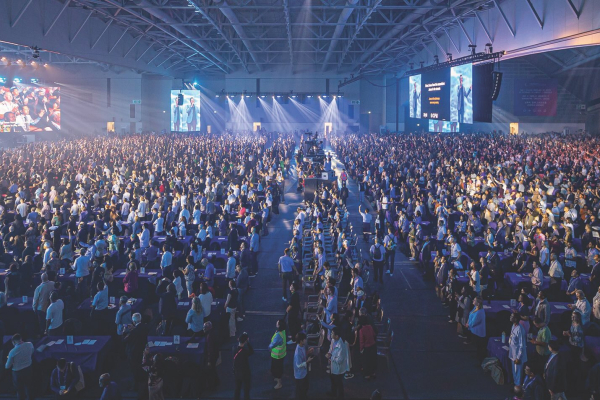
For one week in September of 2024, 5,000 evangelical leaders from over 200 nations descended upon Incheon, South Korea, for the Fourth Lausanne Congress. This was the fourth time, since its inception by Billy Graham and John Stott, that these leaders would gather to discuss how to complete the Great Commission.
At the opening of the congress on Sunday evening, people were excited, nervous, and overwhelmed at the immensity of it, as was I. The schedule began at 9 AM and did not stop until 8:30 PM, so the days were long!
The theme of this congress was to “Declare and Display Christ.” This was done through daily teachings from the Book of Acts. “Declaring Christ” is a nod to Billy Graham’s primacy of Gospel proclamation, and “displaying Christ” illustrated John Stott’s emphasis of Gospel living. These subject matters presented themselves through broad discussions of topics like social justice, Christ in the workplace, gender identity, and persecution. Through the teachings from Acts, there was a focus on the new Church having “all things in common,” how early “missions” were carried out, spreading of the Gospel through persecution, and leading of the Holy Spirit.
A question many of us had is whether the Lausanne Movement would start moving in a liberal direction. While many Western speakers kept their message orthodox and Gospel-focused, several promoted more liberal agendas. For example, during an American climatologist’s discussion on climate change, I heard a litany of catchphrases on social justice issues along with pointed pro-Palestinian/ anti-Israel rhetoric. But when Chinese, African, or Middle Easterners spoke, they often pleaded for increased faith to stand against persecution and the need for greater Gospel access in closed countries. All in all, I think Lausanne nicely balanced agendas, though the topic of “unreached people groups” clearly received less focus during this conference.
Like Lausanne’s 2010 Congress in Cape Town, the best thing about it is the people. Walking down the hall, you will pass Presbyterians, Baptists, Charismatics, Pentecostals, and a few Orthodox. If you walk 20 feet, you pass people from dozens of nations. Over 200 nations are represented, making this the largest, most diverse gathering of evangelical leaders in history. The teachings provided some powerful insights, but it is the living witnesses with whom you share a discussion table, meet in the hallways, and eat meals who truly shape the congress.
I met Igor and Eduardo from Ukraine and asked how I could pray for them. They said, “Don’t pray for our fight against Russia just to end, pray we win the fight.” So, that’s what I prayed. They remarked that the number of baptisms in Ukraine has increased significantly since the beginning of the war.
Another impressive man was my tablemate, Toyin, a pastor from southern Nigeria, who has a heart for unreached people, primarily in Northern Nigeria, where his missionaries labor among territories populated by members of Boko Haram (the ISIS of Africa). Pastor Toyin has 200 congregants and 60% of his church budget is for missions. He has sent out 50 missionaries to northern Nigeria, to work with Muslim peoples. Some of them have been killed by being burned alive in their houses, and another was dragged to death behind a car. Through it all, Toyin declared that suffering is normal for the Christian, and persecution is how the Gospel message goes forward. Globally, 9 out of 10 Christians killed for their faith, live in sub-Saharan Africa.
There is much more to report, and I will be excited to share updates from Lausanne in the coming year with many of our ARP churches.

.png)